
Coloring Memory in Fullmetal Alchemist: Brotherhood


As our team at LMU analyzes early Christian narratives, one of the topics we frequently explore is that of focalization: “who speaks,” “who sees,” and how those perspectives shape a narrative. While this question is often applied to texts, it is equally interesting in visual media, where perspective may be conveyed without text or speech. Animation, in particular, offers striking ways to represent focalization. In Fullmetal Alchemist: Brotherhood, camera angle, color, line definition, and motion are all used to signal not only which character is focalizing a scene, but how the scene is perceived. This is especially evident in the many flashbacks to the Ishvalan War, a past genocide that shadows the entire narrative and is revealed gradually through the memories of those who experienced it. These memory sequences provide a unique opportunity to examine focalization in a visual medium: rather than simply showing what happened, they reveal how different characters see and emotionally process the same events. It is here that techniques beyond simple “camera placement”—especially color and visual distortion—become central to the storytelling.
One of the most recognizable examples of this is in the use of eye color in these memory sequences. Throughout the various characters’ memories of the war, eye color is used to denote race or the extent
to which a character sees race. This can be seen most plainly by comparing the memories of Colonel

Mustang of Amestris and the character only known as “Scar” from Ishval. When Mustang explains the basic events of the war to the protagonists, within his memories from the war, we see a generic shot of multiple Ishvalans. The people in this image are all generic and emotionless. Their only defining feature amidst the almost greyscale image is their startlingly bright red eyes. This can be readily contrasted with the memories of the character Scar who is a survivor of the genocide. In his memories of the war, we see a very similar, generic shot of Amestrian soldiers. Here, the same visual logic applies; only now, the eyes are blue. In contrast, when picturing their own people, both Mustang and Scar do not see eye color. In both cases, the viewers are given a glimpse of, not so much what the characters saw, but how they saw it, and both Mustang and Scar seemingly saw only the race of their enemies.
The perspectives of Mustang and Scar can be contrasted with that of the character Hawkeye, an Amestrian sniper, who is shown repeatedly to feel deep sympathy for the Ishvalan people and to harbor incredible guilt for her part in the war. When she speaks of the war, we see generic shots of both sides, and the difference is stark. First, when she pictures the Amestrian soldiers, she, like Scar,

sees emotionless, generic soldiers, the animators going so far as to re-use the exact same image from Scar’s memories except for one significant detail: their eyes are as dimly colored as everything else. While reused animation can often serve practical, cost-saving purposes, Fullmetal Alchemist: Brotherhood consistently shows a high level of visual precision, leaving room to read this repetition as meaningful rather than incidental. In Hawkeye’s case, she sees a mass of indistinguishable soldiers, but she doesn’t see their race as it’s her own race. By contrast, when we are shown Ishvalans from her perspective, the differences are even more
significant. Not only does she still not see the Ishvalans’ eye color, but she doesn’t see a vague

mass. Instead, she sees unique individuals with clear distinguishing features and those individuals are visibly in pain. In contrast to Mustang and Scar, when Hawkeye remembers the war, she sees her own side as a vague mass of soldiers and the Ishvalans as hurting people, but in both cases, it is not their race that stands out, but their status as military versus civilian and their emotion or lack thereof.
Once this pattern with the eyes is established, however, the animators take the symbolism a step further, using the eye color to communicate plot points within the backstory. There are two cases where this can be seen. The first and most obvious is in Scar’s memory of one of his greatest regrets from the war. He was injured during an assault by an Amerstrian soldier, and he later woke up in a field hospital run by two Amestrian doctors who, despite their orders, insisted on treating any and all
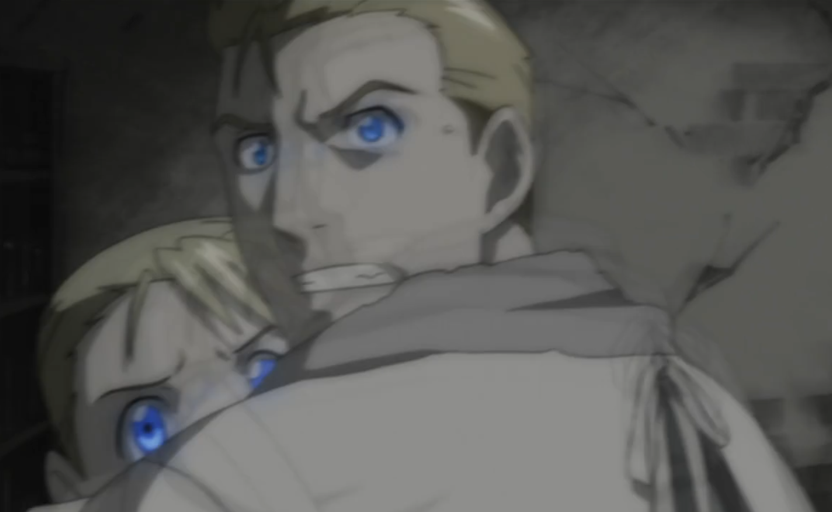
injured, regardless of race. Unfortunately, when Scar awoke he was dazed and traumatized from both his injuries and the massacre of his entire family. So, when he first looks up at the doctors tending him, he does not initially register that they are doctors in a hospital. All he sees are blue eyes. This causes him in his panicked and hate-fueled rage to immediately attack and kill the very doctors who saved his life. Even as the two doctors, a husband and wife, cower back from Scar right before he strikes, Scar doesn’t see the obvious fear of civilians. He sees only the blue eyes. All of this is communicated, without any narration or commentary, through the coloration of the doctors’ eyes and the fuzzy framing and line work of the images in this scene. The detail of the eyes calls back to the soldiers from before, and Scar’s following actions, while horrifying, immediately make sense to the viewer.
In a similar, albeit far less dramatic, way, we see eye color used to great effect in Hawkeye’s memories. Despite the fact that her memories do not normally include the brightly colored eyes, there
is one scene where they do. When she recalls the tragic encounter between an Amestrian soldier and an Ishvalan child which started the war, an event she most likely did not witness herself, she sees both

the soldier and the child with brightly colored eyes. Although Hawkeye generally seems not to see race, when she pictures this moment which she has to imagine since she wasn’t there, she sees them explicitly as their races. In this case, race is central to the moment. While Hawkeye normally sees people rather than races, here she sees an Amestrian and an Ishvalan, distinguished solely through their eye color.
Yet, eye color is not the only way in which the animators of Fullmetal Alchemist: Brotherhood portray focalization through color. Another factor is the color saturation of the scenes. Although all of the examples used thus far were in near-greyscale, the saturation of the color in these flashbacks actually fluctuates. This fluctuation appears to reflect either what stands out most to the focalizer, like

eye color, or the degree to which the event has been emotionally processed. This can be seen most starkly if we compare Scar’s memory of the attack in which he was injured and his family killed with the recollection of the same event by Dr. Marco. Marco is a scientist who built weapons for the war, including the one used to kill Scar’s family. The image in both cases is again identical; however, the color gradient is strikingly different. Scar, who is portrayed as an extremely angry, conflicted, and vengeful character throughout the anime, remembers the moment of his greatest trauma in near black-and-white, demonstrating the extent to which he has not come to terms with what happened. However, Marco is portrayed as having fully faced what he did, accepted the guilt, and begun to live a very different life in an effort to make up for his past crimes, to whatever small degree possible. So, when Marco remembers the event, he sees it in full color, reflecting the extent to which he has processed the event and his role in it.
This effect is taken even further when the coloration of a single character’s memories fluctuate to show different levels of emotional processing and character development. Consider Hawkeye’s memory of one of Mustang’s flame attacks. In contrast to her memories of most of the war, she remembers Mustang’s role vividly within the same episode. Why is this? It is likely because her close

relationship to and feelings for Mustang have forced her to reckon with what he did far more thoroughly than she has ever faced her own actions. So, when she remembers looking down the scope of her sniper rifle, she sees in faded colors. But when she remembers Mustang’s fiery attacks, she sees in bright, vivid color. Similarly, other characters will see an entire scene in muted color, but see Mustang’s flames, and only his flames, in bright color, likely signaling the extent to which his brutal, fiery attacks in particular remain vivid in the memories of those who witnessed them. Only in Hawkeye’s memories is the entire scene as vivid as the flames.
Another example of fluctuating color lies in Scar’s memories. For most of the anime, Scar’s memories remain stubbornly greyscale—even memories of recent events from within the main storyline. However, toward the end of the story, after Scar has processed his past and emotions and begun to let go of some of his anger, his memories begin to gain color. Compare Scar’s memory of his brother working in his study in episode 22 to a similar memory in episode 61. It is a detail easy to

miss due to how far the two moments are separated, but the contrast becomes apparent when the two are viewed together. By the final time we see Scar’s memories in the show, his view of the past has gained color. It is not yet vividly colored, but it is no longer practically greyscale. This likely shows his character development as he has grown from seeking hate-filled revenge to fighting to protect innocent lives and prevent such a horrific crime from recurring. The still semi-faded colors show that he hasn’t completely healed, a fact stated aloud in the same scene, but he has come a long way from the beginning of the story.

This use of color as a reflection of the focalizer extends even to moments where characters reconstruct events they did not witness, such as Hawkeye’s account of the war’s inciting incident. Immediately after Scar’s description of his brother in his study in episode 61, we see the character Hohenheim retell the same scene based on Scar's account. However, when Hohenheim describes the scene second-hand, it is visually shaped not only by Scar’s account, but by Hohenheim’s own memories, borrowing the warm lamplight associated with his own study, as seen elsewhere in the series. Even imagined scenes are filtered through the emotional and experiential framework of the one who envisions them.
Fullmetal Alchemist: Brotherhood demonstrates how focalization can be conveyed visually rather than textually. Through choices in color, line definition, and framing, the series shows not simply what happened, but how different characters perceive and emotionally process the same events. In doing so, these flashbacks reveal that memory in the series is not neutral or objective, but deeply shaped by guilt, trauma, and perspective. Here, animation does what written narration often does: it makes the gap between event and experience visible, but without the need for a single word.
Cover image generated with ChatGPT and edited by the author. All other images are screenshots from Fullmetal Alchemist: Brotherhood (2009), Studio Bones, used for purposes of commentary and analysis.


Comments